
Nevada Criminal History Checks
A Nevada record check should follow the record from its creator to each later custodian. Begin with Nevada Police for a Nevada incident or arrest report. Move to the county roster for live Nevada custody, then to the clerk for a filed Nevada case. Iowa DCI is the statewide option after Nevada and court sources have been distinguished.
- Use the Nevada Police official page to confirm the current report-request contact and city process.
- Ask Nevada Police for the report when its officers created the incident or arrest record.
- Check Story County's Current Inmate Roster for recent county custody.
- Search Iowa Courts Online with Story County selected, then ask the clerk for official copies.
- Request an Iowa DCI check for a formal statewide Iowa criminal-history product.
Do not assume every event inside or near Nevada belongs to the city department. The sheriff, Iowa State Patrol, and other agencies retain their own reports. A booking entry or docket may identify the arresting agency.
Nevada City and County Records
The most common Nevada records mistake comes from Nevada's role as county seat. Nevada Police is a municipal agency. Story County Sheriff, Story County Jail, the county attorney, and the Iowa District Court clerk are county or state-system custodians. Their Nevada offices may be close, but their files serve different legal functions.
| Record | Starting Custodian | What It Establishes |
|---|---|---|
| Police incident report | Nevada Police | The city officer's narrative and actions |
| Booking record | Story County Jail | Intake, custody, charge, and release data |
| Criminal case | Story County clerk | Filed charges, docket, and disposition |
| State history | Iowa DCI | Releasable Iowa history under chapter 692 |
A request for one product does not automatically search the others. Compare them when the goal is to understand the full path of a Nevada event.
The Nevada distinction also matters when correcting an error. Nevada Police can address a report it created. The sheriff or jail controls the booking layer. The clerk is the source for a filed disposition, and DCI has its own process for the statewide history. Send proof of a correction or court order to the custodian whose copy is wrong instead of asking one office to rewrite every connected system.
Records at the Nevada Police Department
The Nevada Police Department's official page is the first source for current city contact and report-request instructions. The indexed research did not confirm a distinct name-search portal, a dedicated records form, exact desk hours, or a records-unit telephone. Those details should be checked on the live city page before a request.
The manifest preserves a view of that official Nevada source.
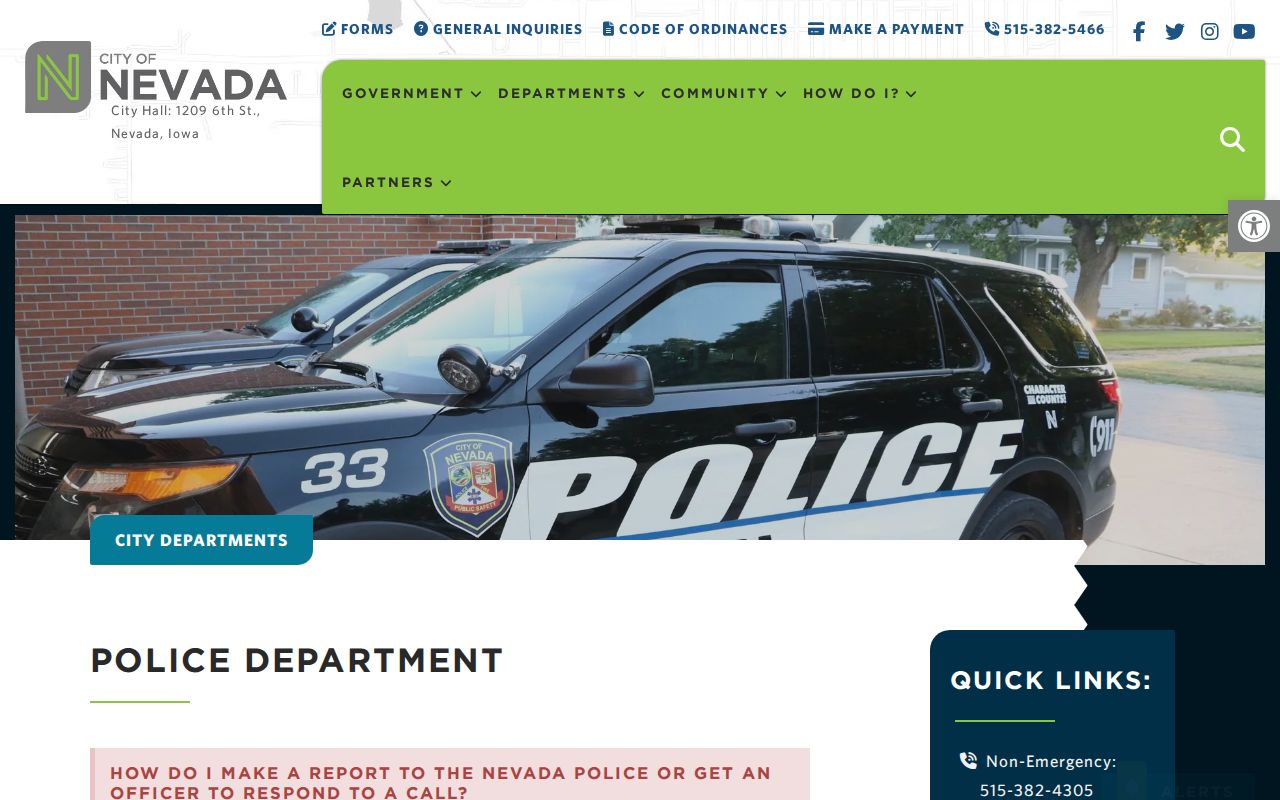
The department holds Nevada reports its officers create, while the county jail and court maintain later Nevada records.
Describe the event, date, location, and report number if known. City police files can include narrative, call information, statements, evidence references, and officer actions. Protected victim information, juvenile content, active investigation material, and other confidential details may be redacted.
Choosing Nevada's Record Counter
The Story County Justice Center at 1315 South B Avenue is the local hub for sheriff, jail, clerk, court, and county attorney work. A person entering one complex can still be asking four different offices for four different records. State the record type before describing the person or event.
- Ask Nevada Police for the city officer's report.
- Ask the sheriff or jail for a custody or booking record.
- Ask the clerk for the official criminal case and copies.
- Ask the county attorney only about prosecution-office records it is legally able to release.
County Administration at 900 Sixth Street is not the criminal-record counter. Calling the appropriate office before a visit is useful because counter access, copy methods, and confidential review can differ.
Booking and Arrest Records in Nevada
A Nevada Police arrest can move only a short distance into county custody, yet the Nevada event still creates separate records. Nevada Police retains the arresting officer's report. Story County Jail creates the Nevada intake file and current custody entry. The county attorney later decides which state charges to prosecute, so the first Nevada arrest label may differ from the filed case.
The official Story County jail page explains the Justice Center's jail function and direct-supervision model. It also gives the county context for a city arrest that moves into custody.
For a fresh arrest, the county roster is more current than Iowa DOC's weekly offender search. For a past arrest, use the arresting agency report and the court docket. The roster is not an archive of every Nevada arrest and does not prove a final court outcome.
Current and Older Nevada Arrests
Current Nevada custody and Nevada arrest history answer different questions. The Story County roster is useful when someone may be held now after a Nevada event. It can show booking and custody details supplied through the jail channel. Once the person leaves custody, an older Nevada arrest may no longer be discoverable there.
For an older event, identify the arresting agency and request its report. Search Iowa Courts Online for the filed criminal case. If a court case is pre-1998 or does not render online, contact the Story County clerk. If no charge was filed, the police or sheriff record may be the only local source, subject to public-access limits.
For statewide releasable history, Iowa DCI requires exact identifying data and a $15 fee for each last name searched. That product covers Iowa, not federal or out-of-state records.
DCI also applies a release distinction. Without signed subject authorization, completed deferred judgments and arrests more than 18 months old without a final disposition are not released in the same way. A “no record” response can therefore reflect a legal release limit, a confidential juvenile history, or no releasable match. It should not be treated as a replacement for the Nevada police report and court search.
The Nevada Municipal Court File
Nevada has no separate municipal criminal-history database identified in the official research. Iowa's unified district court handles filed criminal matters. A city citation or Nevada Police case that enters court becomes a Judicial Branch file held by the Story County clerk.
| Court Name | Iowa District Court for Story County within the Second Judicial District. |
|---|---|
| Case Types | Felony, misdemeanor, traffic, and filed local matters assigned in the unified court system. |
| Lookup Channel | Iowa Courts Online, filtered to Story County, plus the clerk for official copies. |
| Docket Contents | Case number, charges, filings, hearings, orders, disposition, and sentence. |
| Copies and Fees | Confirm current access and cost with the clerk; no current local copy fee was verified. |
The court file is not a police report. It reflects the charge as filed and later court action, which may differ from the allegation shown at booking.
Common Iowa case prefixes help read Nevada results. FECR marks a felony criminal file, AGCR an aggravated misdemeanor, SRCR a serious misdemeanor, and SMCR a simple misdemeanor. The prefix is a filing key, not the final result. Charges may be amended, dismissed, or resolved at a different level, so read the docket and disposition for each count.
Nevada's 2002 Records Milestone
The current Justice Center opened in March 2002 and replaced a linear-style jail that had operated since 1968 with 31 beds. The new complex brought courtrooms, judges, clerk, county attorney, sheriff, and jail functions together. Its original modular direct-supervision design was described as 104 beds, while a current sheriff division page describes 122 operating beds. Those figures refer to different points in the facility's life.
Centralization changed Nevada's records geography, but not records ownership. The city police report still begins with Nevada Police. Jail records belong to the county custody system. Court records remain Judicial Branch files. Prosecution records have their own custodian and restrictions.
The facility's location makes Nevada a practical county records center. It does not turn a city police request into a countywide search.
How Nevada Records Reach the County
A Nevada case moves through a chain of distinct systems. Nevada Police creates the initial report. Story County Jail adds a Nevada booking when custody occurs. The county attorney selects Nevada charges for prosecution, and the clerk maintains the court file. Nevada fingerprint and disposition reporting can later feed the Iowa DCI repository.
Record flow: Nevada Police › Story County Jail and Iowa District Court › Iowa Department of Public Safety, Division of Criminal Investigation
A gap in one layer does not settle what happened in another. A roster entry can precede a case. A court dismissal does not by itself erase the city report. A DCI result can omit information that is confidential, not fingerprint-backed, or not yet matched to a disposition.
Fingerprint reporting is especially important. DCI states that an arrest must be fingerprinted and submitted to create a fingerprint-backed state history cycle. The Judicial Branch later reports the court result so it can be associated with that cycle. Missing fingerprints, a delayed disposition, or a failed match can leave the Nevada police, court, and repository views out of sync.
Nevada Criminal Prosecution Records
The Story County Attorney prosecutes state criminal laws and county ordinances. Its main Nevada office is inside the Justice Center at 1315 South B Avenue. The office lists 515-382-7255 and weekday hours of 8 a.m. to noon and 12:30 to 4:30 p.m.
The official County Attorney page is the source for those duties and contacts.
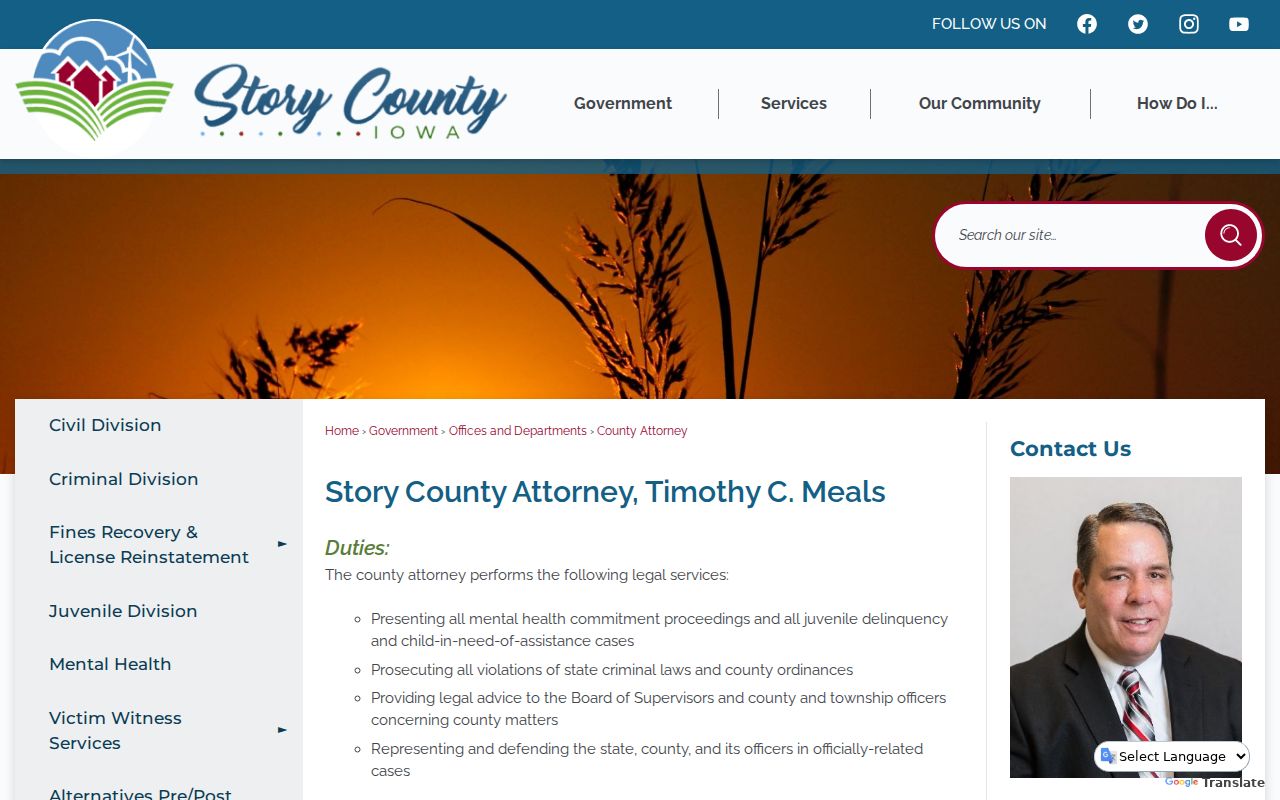
The prosecution office does not replace the clerk as custodian of the filed court case.
A prosecutor's working file can include material not found in the public docket, and not all such content is open. To learn the filed charges, hearings, outcome, and sentence, use the clerk and Iowa Courts Online. The county attorney cannot advise or represent a private requester.
Nevada Records Beyond City Files
Iowa DOC records become relevant when a Nevada case results in prison, probation, parole, work release, or another community-based status. Iowa Offender Search updates weekly and is not the same as the live county jail roster. A specific DOC public-record request is the fallback for releasable correctional material that the locator does not show.
The Iowa DOC open-records request page describes that state channel.
DOC may withhold treatment, medical, safety, and other confidential supervision information, even when a public status appears online.
Physical photocopies are listed at $0.15 per page for the DOC process. That price should not be applied to Nevada Police, the clerk, or the sheriff, whose current local copy fees were not confirmed.
Nevada Record Access Rules
Nevada Police records fall under Iowa's public-record framework, but chapter 22 preserves confidential categories. Active investigation details, juvenile files, protected victim information, medical data, and personal identifiers can be redacted or withheld. Court access also depends on court rules, expungement orders, and statutory confidentiality.
Key Statutes:
Iowa Open Records Law, chapter 22 provides inspection rights while section 22.7 protects listed confidential records.
Iowa Code chapter 692 governs state criminal-history dissemination and subject authorization.
Iowa Code chapter 901C controls qualifying expungement and resulting confidentiality.
The Iowa Legislature's current chapter 22 text is the primary source for the open-record rule.
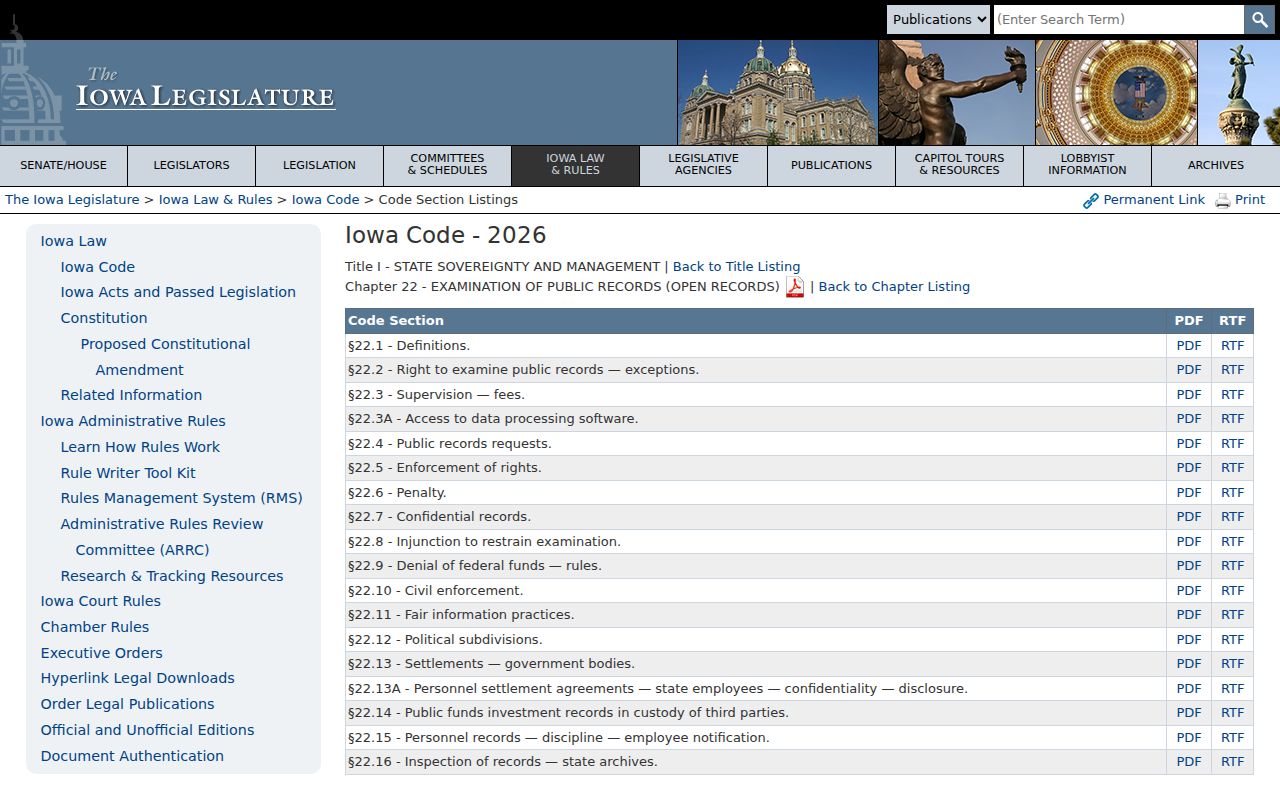
The statute supports specific requests to the office that holds the record, not one broad demand to every agency in the Justice Center.
Ask for inspection or electronic delivery when either format will meet the need. Give a useful date range, location, event type, and case or report number. If material is withheld, the custodian can identify the governing confidentiality rule. The Iowa Public Information Board offers guidance and a complaint channel for chapter 22 disputes, but it does not act as Nevada's records counter.