
Criminal Court Cases in Story County
Story County criminal prosecutions belong to Iowa's unified District Court system. The Iowa District Court has general jurisdiction over felonies and indictable misdemeanors. Magistrates and associate district judges handle matters assigned to them by law, including lower-level proceedings within that same state system. Ames, Nevada, and Huxley do not maintain separate municipal criminal dockets. A city citation or ordinance prosecution may begin with local police or City Legal, yet the official case file remains a Judicial Branch record.
The Story County Clerk of District Court is the file custodian. Records are available through the Justice Center in Nevada and the satellite clerk at Ames City Hall. This distinction prevents a common error: police keep the incident report, the jail keeps the booking entry, and the clerk keeps the filed criminal case. The clerk's file is the place to confirm the formal counts, court orders, disposition, and sentence.
The Story County Attorney prosecutes state criminal law and county ordinances from offices in Nevada and Ames. That office's charging work appears in the court record only when filed. Its internal prosecution file is not the same public product as the clerk's docket, and the office cannot give private legal advice.
Search Story County Courts Online
Iowa Courts Online is the public discovery layer for most Story County criminal court cases filed from 1998 forward. Basic searches are free. The Judicial Branch's official Iowa Courts Online guide explains the public and subscriber fields. A paid subscriber view exposes more trial-court detail and document access, while document images, certified copies, and some older files still require the clerk. Entries update in real time after court staff place them in the statewide case-management system.
The official portal view shows the controls used to narrow a Story County court case lookup.
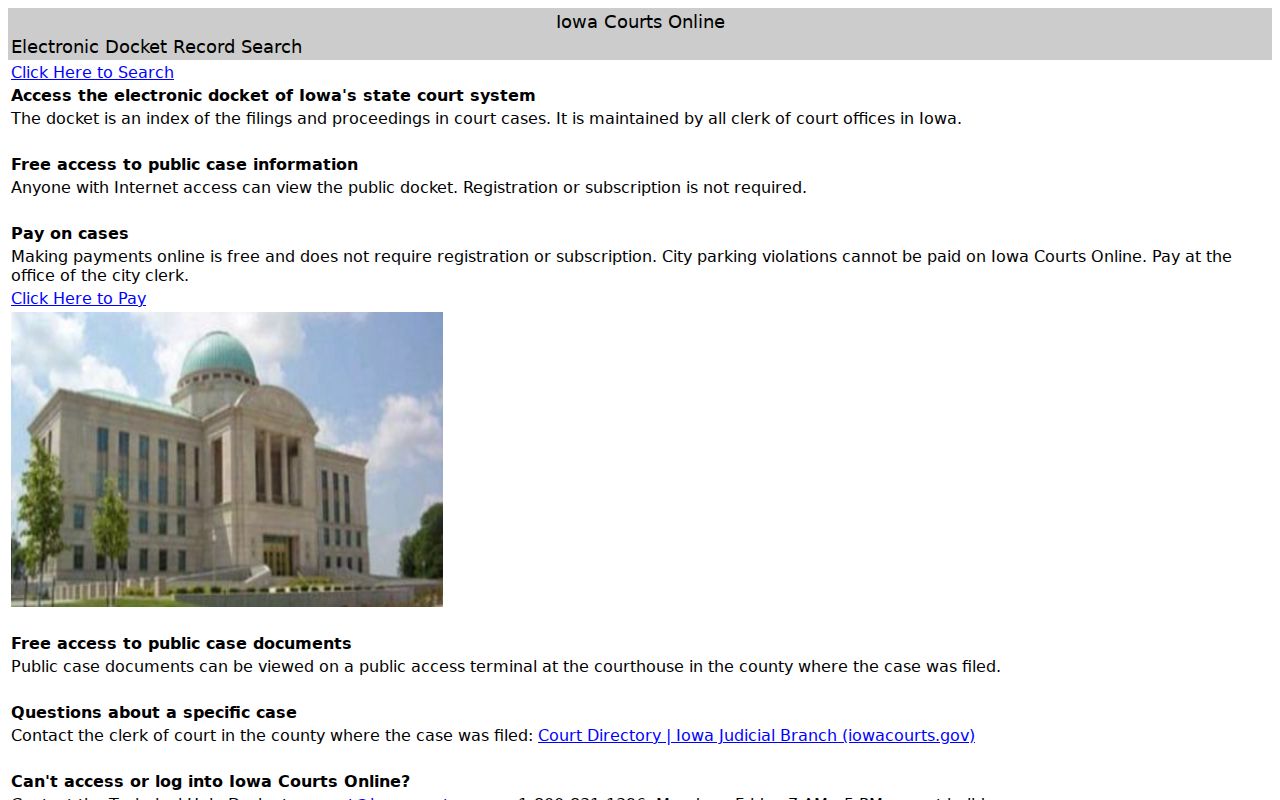
Selecting Story as the county before opening a result cuts down false matches and keeps the search tied to the correct clerk.
Public results commonly identify the case title, number, county, type, parties, lawyers, charges, and filings. Subscriber access can add fuller docket, judgment, financial, exhibit, property, and traffic information. Neither view opens documents that Iowa law or a court order keeps confidential.
Story County Case Record Searches
Use a known case number when possible. A name search is broader, so compare middle initials, case type, and the filing context before deciding that a result concerns the right person. The public index may not return a confidential, sealed, expunged, or pre-1998 case. An absent result therefore calls for a clerk inquiry, not a firm conclusion.
- Open Iowa Courts Online and choose the trial-court or case-search screen.
- Enter the case number, or use the party's last and first names.
- Select Story County and narrow the case category to criminal when that control appears.
- Open the matching docket and read each count, filing, and disposition separately.
- Ask the Story County clerk for old files, document images, or certified copies not available online.
| Field Label | Type | Required | Notes |
|---|---|---|---|
| Case Type | Dropdown | No | Choose trial court or a criminal category where shown |
| County | Dropdown | No | Select Story |
| Case Number | Text | No | Use an FECR, AGCR, SRCR, or SMCR prefix plus digits |
| Party Last Name | Text | Conditional | Spelling and compound surnames matter |
| First and Middle Name | Text | No | Use to separate common names |
| Filing Date Range | Date controls | No | Availability varies by search view |
A case number is the cleanest key because it ties every docket entry to one proceeding. When searching by name, keep all plausible results open until the county, case prefix, and surrounding details support a match.
Two Story County Court Counters
The Justice Center at 1315 S. B Avenue in Nevada brings the district courtrooms, judges, clerk, sheriff, jail, and County Attorney together. Ames City Hall at 515 Clark Avenue has a different but useful arrangement: Ames Police is on the first floor, while a Second Judicial District courtroom and clerk satellite sit on the second. A police report requested downstairs is not the same record as the filed court case requested upstairs.
Call the Story County clerk at 515-337-8300 before traveling and confirm current counter hours, copy methods, and fees. The official court guide previously listed ordinary photocopies at $0.50 per page, but current certification and search charges should be confirmed before ordering. For a case older than the online system's general 1998 coverage, give the clerk the name, approximate year, and any known case number or charge.
Story County Clerk of Court
Justice Center
1315 S. B Avenue
Nevada, IA 50201
515-337-8300
Confirm counter hours before visiting.
Ames Clerk Satellite
Ames City Hall, second floor
515 Clark Avenue
Ames, IA 50010
515-337-8300
Confirm available services before visiting.
What a Criminal Case File Contains
A Story County court file is organized around the case and its individual counts. The header gives a fast orientation, but the docket supplies the sequence. A reader should trace the complaint or trial information, later amendments, pleas, rulings, judgment, and sentence. Financial entries may show costs, fines, surcharges, restitution, payments, or a balance in views where those details are public.
| Case Number & Court | County, case prefix, case type, status, filing date, and case title. |
|---|---|
| Charging Document | Complaint, trial information, or indictment and the charge alleged in each count. |
| Docket Entries | Appearances, motions, orders, pleas, warrant events, judgment, and later filings. |
| Hearing Dates | Hearing type, date, time, place, and judge when entered and public. |
| Disposition & Judgment | The outcome of each count, which may differ within one case. |
| Sentence & Conditions | Custody, probation, financial obligations, and other public terms ordered by the court. |
A case header marked closed does not say how every charge ended. Read the disposition attached to each count. That is the clearest way to distinguish a conviction, dismissal, or acquittal.
Decode Story County Case Numbers
Iowa's prefixes help identify the broad criminal level. FECR marks a felony criminal case, AGCR an aggravated misdemeanor, SRCR a serious misdemeanor, and SMCR a simple misdemeanor. The prefix is a filing category, not the complete outcome. Charges can be amended, dismissed, replaced, or resolved differently from one count to the next.
- Complaint
- A sworn allegation that starts a criminal matter.
- Trial information
- The Iowa prosecutor's formal charging document for an indictable offense.
- Disposition
- The current or final outcome assigned to a specific charge.
- Deferred judgment
- A judgment held back while court conditions are completed; successful discharge is not a conviction.
- Mittimus
- The court order committing a sentenced person to custody.
These terms also explain why the booking charge and the filed count need not match. The County Attorney reviews the arrest material and decides which state charges to prosecute.
Criminal Case Stages in Story County
A Story County arrest or summons can begin the process, but not every arrest produces a filed prosecution. A judicial officer handles the initial appearance and release decision. The County Attorney may then file a complaint or trial information, change the proposed counts, or decline to proceed. Arraignment addresses the formal charge and plea. Discovery, motions, negotiations, and hearing settings follow before a plea or trial resolves the case.
Case flow: Charges Filed › Arraignment › Pretrial › Plea or Trial › Disposition › Sentencing
Appeal and postconviction filings can add later docket events. Timing varies with custody status, the type of charge, continuances, and Iowa's procedural deadlines. The docket should be treated as a changing record until all counts have a final outcome.
Federal Cases Affecting Story County
Federal criminal cases are not stored in the Story County clerk's index. Story County lies in the Southern Division of the U.S. District Court for the Northern District of Iowa. That court's official site identifies its divisions and public services.
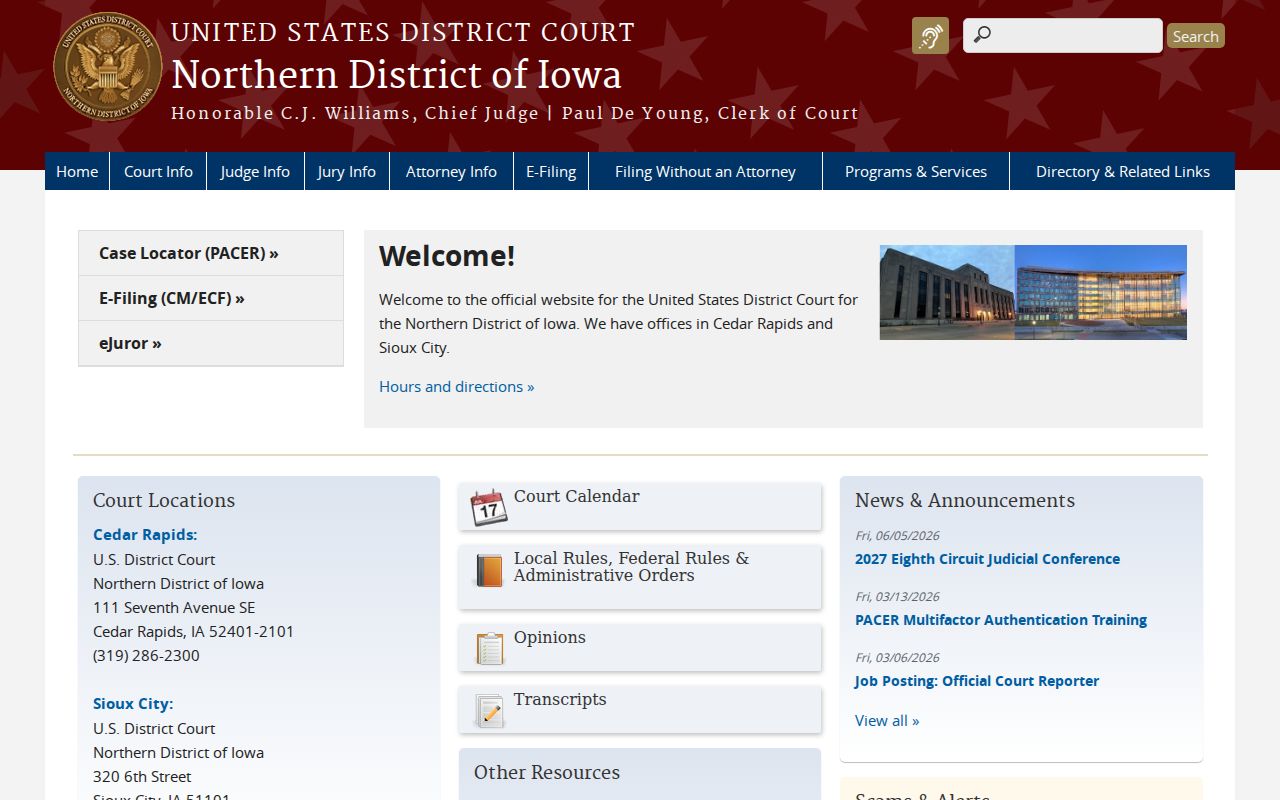
The federal district court layer is separate from Iowa Courts Online, even when conduct occurred in Story County.
Public federal docket discovery runs through PACER. Registration is required, fees follow PACER's current schedule, and sealed criminal matters remain unavailable.
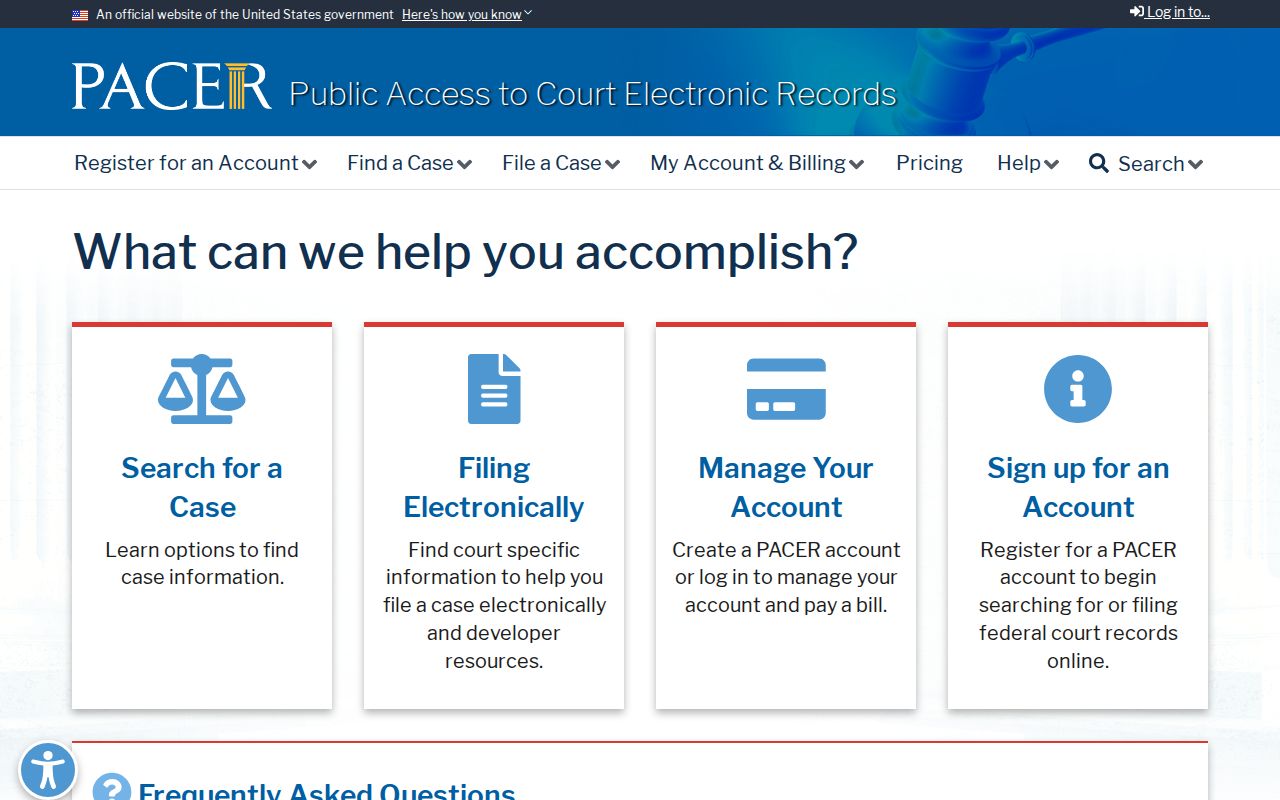
PACER may show docket events, counsel, hearing notices, judgments, and public documents, but it does not replace the state clerk for a Story County prosecution.
Dismissals and Story County Expungement
A dismissed or not-guilty Story County case may qualify for expungement under Iowa Code chapter 901C, subject to the law's conditions and exceptions. A narrow misdemeanor remedy also exists after the required waiting period and satisfaction of court debt, but many offense groups are excluded. Eligibility should be checked against the current statute and the actual docket rather than inferred from the case status alone.
The official statute source shows the rules that control access after an Iowa expungement order.
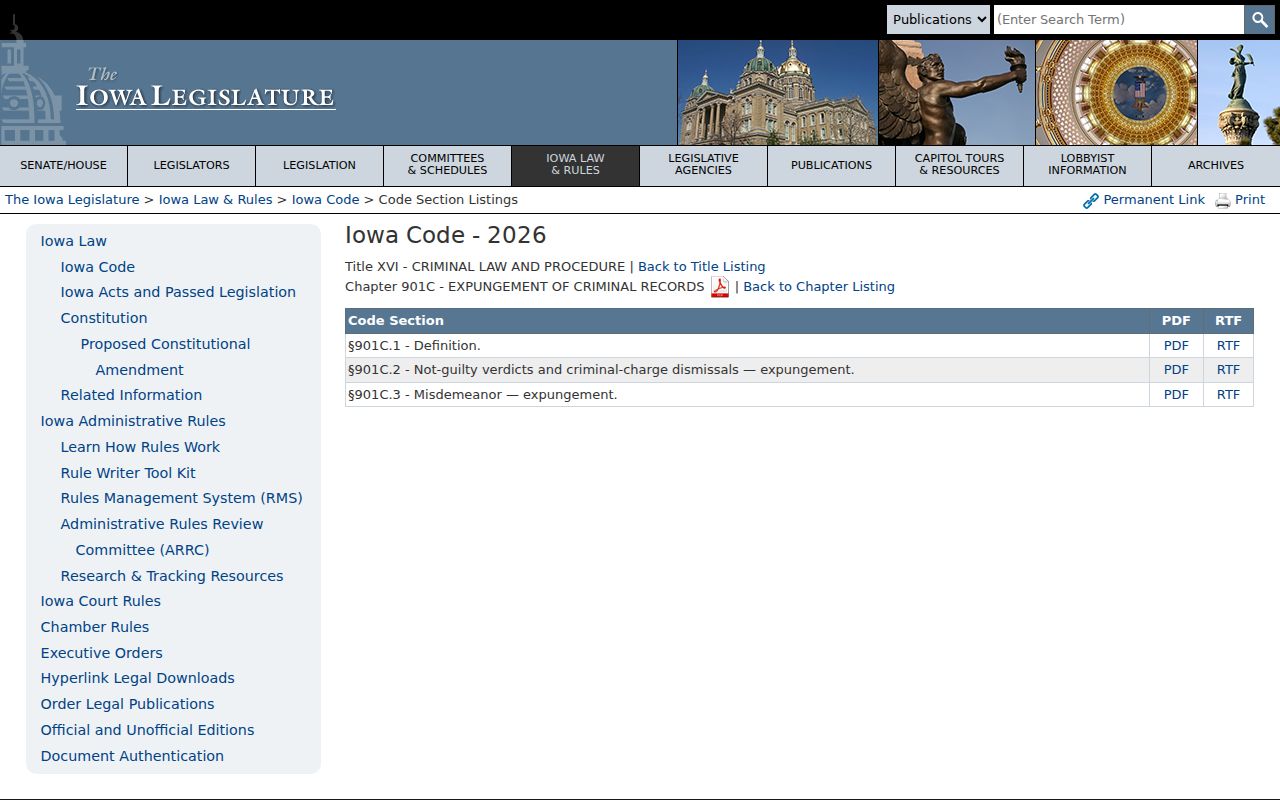
After an order, verify both the Story County court layer and one's own DCI history. A successfully discharged deferred judgment follows section 907.9 and differs from the chapter 901C misdemeanor process.
Access Rules for Case Records
Iowa Code chapter 22 supports access to open government records, while Judicial Branch rules govern court-file access and the protection of personal data. Public dockets omit protected identifiers. Juvenile court records are generally confidential under section 232.147, and sealed or expunged Story County criminal court cases do not remain openly retrievable. Victim data, medical information, and confidential documents can also be withheld or redacted.
Online access is only one channel. Ask the clerk about a missing docket, pre-1998 material, inspection, or a certified copy. A specific request should identify the name, case number if known, approximate date, and document sought. The clerk cannot disclose material that the law or a court order keeps confidential, but can explain the available record product and current copy procedure.
If an access denial concerns a county-held record rather than a Judicial Branch case file, the Iowa Public Information Board offers chapter 22 guidance and a complaint channel. Keep the custodian distinction clear: court-record access questions start with the clerk, while a sheriff or prosecution record request goes to the agency that maintains it.